
Swallowing is one of the most complex physical actions your body performs. It requires over 30 muscles and six cranial nerves to coordinate in a precise sequence that takes less than two seconds. When a stroke, brain injury, head or neck surgery, Parkinson’s disease, or prolonged intubation damages any part of that sequence, the result is dysphagia — difficulty swallowing. Food or liquid enters the airway instead of the stomach. The body coughs to protect itself, but if the cough reflex is also weakened, material enters the lungs silently. That’s called silent aspiration, and it leads to aspiration pneumonia without any warning signs. At Dolphin Pointe, our speech-language pathologists specialize in diagnosing and treating adult dysphagia. We evaluate the specific phase of the swallow that’s failing, determine which food and liquid textures are safe right now, and build an exercise program that strengthens the swallow reflex so you can return to a normal diet as quickly as your body allows. We serve both inpatient and outpatient clients at our rehabilitation center in Jacksonville’s Arlington neighborhood.
What Swallowing Disorder Therapy Includes in Jacksonville
Our dysphagia program starts with a clinical swallow evaluation. Your speech-language pathologist watches you swallow different textures — thin liquid, thickened liquid, puree, soft solid, and regular solid — and observes how your mouth, throat, and larynx respond. They listen for wet vocal quality after each swallow (a sign that material is sitting on the vocal cords), watch for delayed swallow initiation, and assess whether you cough or clear your throat during or after eating. From this evaluation, your therapist determines which phase of the swallow is impaired: the oral phase (moving food to the back of the mouth), the pharyngeal phase (triggering the swallow reflex and protecting the airway), or the esophageal phase (moving food from the throat to the stomach). Each phase has different muscles, different nerves, and different treatment exercises.
Treatment combines three components. First, safe diet recommendations — your therapist determines which food and liquid textures you can swallow safely right now and communicates those guidelines to our nursing and dietary teams. For inpatient residents, every meal is prepared to match these guidelines, and our nursing staff monitors eating at every meal to watch for signs of difficulty. Second, swallow strengthening exercises — targeted exercises that rebuild the specific muscles involved in your swallow deficit. Tongue strengthening for oral phase weakness. Effortful swallow drills and Mendelsohn maneuver practice for pharyngeal phase delays. Laryngeal elevation exercises for airway protection. Third, compensatory strategies — head positioning techniques, swallow timing cues, and bolus size modifications that make swallowing safer while the muscles are still rebuilding. Patients from Arlington, University Park, Fairways Forest, and across Jacksonville work with our SLP team on swallowing goals measured by what they can eat safely — not just how their throat muscles perform on a test.
Why Swallowing Disorder Therapy Matters in Jacksonville
Aspiration pneumonia is one of the leading causes of hospital readmission and death in stroke patients, and Jacksonville’s hospital systems treat thousands of stroke patients every year. The pattern is predictable: a patient has a stroke, survives, begins to recover movement and speech, but the swallowing muscles were also affected. The patient goes home on a modified diet, but at home nobody monitors every meal. Food or liquid enters the airway. A fever develops days later. The patient is readmitted with pneumonia. This cycle repeats across Duval County every week. Dysphagia therapy breaks the cycle by strengthening the swallow, training the patient on safe eating techniques, and — for inpatient residents — providing meal-by-meal monitoring that catches problems before they become pneumonia.
Beyond stroke, swallowing disorders affect patients recovering from head and neck cancer surgery, prolonged intubation in the ICU, Parkinson’s disease, and other neurological conditions. Many of these patients don’t realize they have a swallowing problem until they aspirate — because the cough reflex that normally warns you is also weakened. Silent aspiration is one of the most dangerous complications in rehabilitation, and it’s one of the reasons Dolphin Pointe’s model of care — where speech therapy, nursing, and dietary services are all under the same roof — produces safer outcomes than home-based recovery. Our nursing staff doesn’t just deliver meals. They monitor residents during meals using the safe eating protocols our SLP team prescribed. That daily coordination between therapy and nursing is what prevents aspiration between sessions. Families from Colony Cove, Springfield, San Marco, Mandarin, and across Duval County choose Dolphin Pointe for dysphagia therapy because the level of swallow safety monitoring we provide around the clock is something outpatient clinics and home health services can’t replicate.
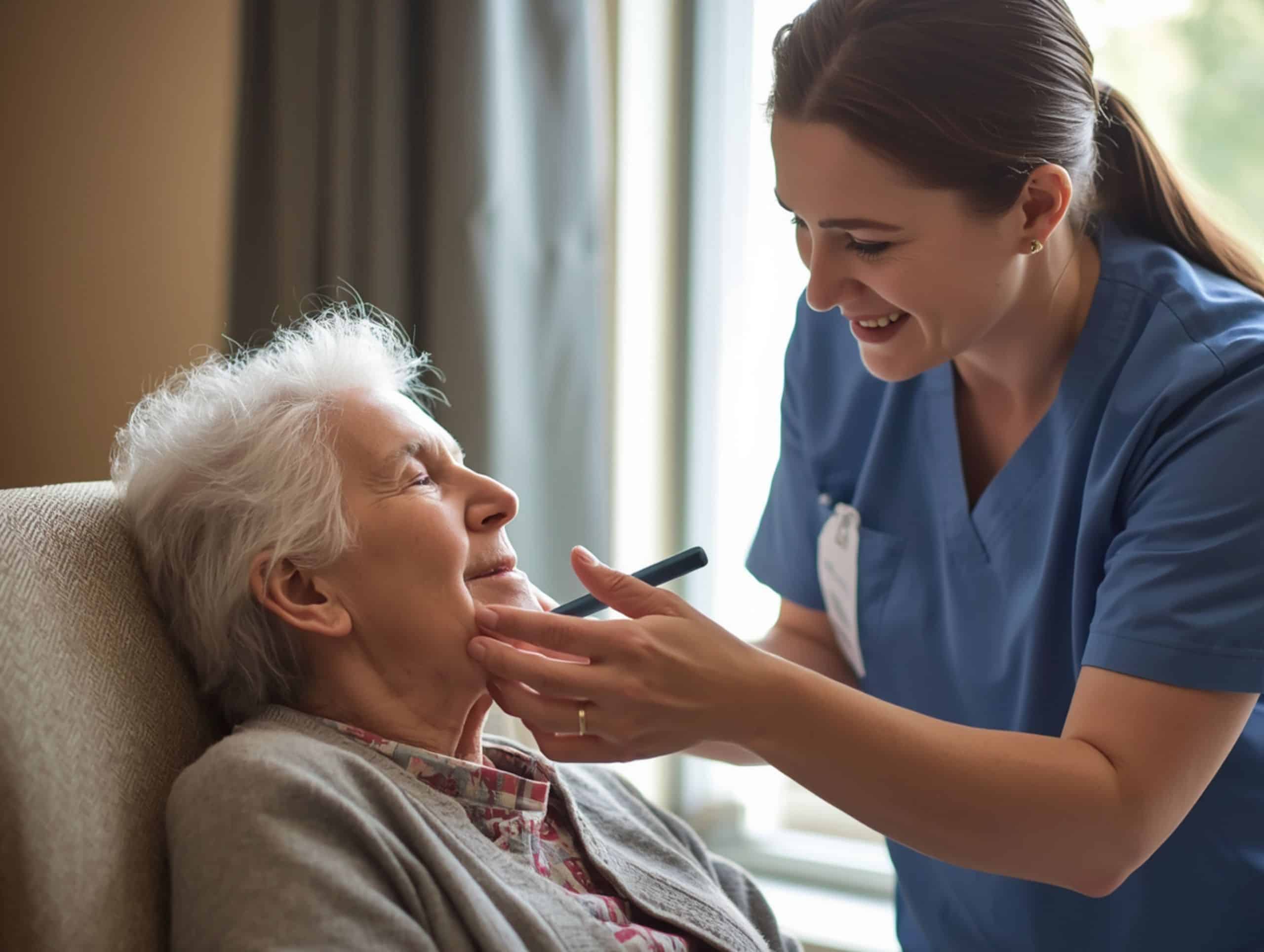
What to Expect During Swallowing Disorder Therapy
1. Referral and clinical swallow evaluation. Your physician, neurologist, or hospital discharge team sends a referral. Your speech-language pathologist performs a bedside swallow evaluation using different food and liquid textures. If the clinical evaluation suggests a more detailed assessment is needed, your therapist coordinates instrumental testing (such as a modified barium swallow study) with your physician.
2. Safe diet determination and team communication. Based on your evaluation, your therapist determines which textures you can swallow safely and communicates those guidelines to nursing, dietary, and your family. For inpatient residents, every meal is prepared to match these specifications. Your therapist also identifies the specific swallow deficit to target in treatment.
3. Swallow strengthening and compensatory training. Sessions combine targeted muscle exercises with compensatory strategies — head positioning, swallow timing, and bolus control techniques. Your therapist progressively upgrades your diet texture as your swallow strength improves. Nursing monitors every meal and reports any signs of difficulty back to the therapy team.
4. Diet advancement and discharge. The goal is returning you to the least restrictive diet your swallow can handle safely — ideally a regular diet with no modifications. Your therapist tracks swallow strength and diet tolerance at every session. When you’ve reached the safest diet level your swallow allows, you’re discharged with clear written guidelines on what textures are safe, what to watch for, and when to seek re-evaluation. Your physician receives a full swallowing status report.
Swallowing disorder therapy is part of our speech therapy program at Dolphin Pointe Health Care. We also offer treatment for aphasia, dysarthria, voice disorders, and cognitive-linguistic deficits under our speech pathologist services in Jacksonville, FL.
Swallowing Disorder Therapy Related Programs
Swallowing Problems Don’t Get Better on Their Own. Call Today.
If you or a family member is coughing through meals, choking on liquids, or avoiding foods because swallowing has become difficult, a speech-language evaluation can identify the problem and start treatment before aspiration becomes pneumonia. Call 904-914-8801 to schedule an evaluation. We serve patients from Arlington, University Park, Springfield, San Marco, Riverside, Mandarin, Orange Park, Regency, Downtown Jacksonville, and the Beaches communities.
Dolphin Pointe Health Care
5355 Dolphin Point Blvd, Jacksonville, FL 32211
Phone: 904-914-8801
Open 24 Hours