
Joint replacement rehabilitation is time-sensitive. The first six weeks after a hip or knee replacement are when your body lays down new tissue around the implant, forms the scar tissue that either helps or hinders your range of motion, and establishes the movement patterns you’ll carry for the life of the joint. If rehab starts late, progresses too slowly, or follows a generic program instead of your surgeon’s protocol, the window for full range of motion closes — and what you end up with at week eight is likely what you’ll have permanently. At Dolphin Pointe, our joint replacement rehab team follows procedure-specific protocols for total hip, total knee, partial knee, shoulder, and revision replacement surgeries. Therapy starts within the first day of admission. Our heated aquatic therapy pools let you practice walking and bending in warm water that supports your body weight weeks before those movements would be comfortable on land. We serve both inpatient and outpatient joint replacement patients at our rehabilitation center in Jacksonville’s Arlington neighborhood.
What Joint Replacement Rehab Includes in Jacksonville
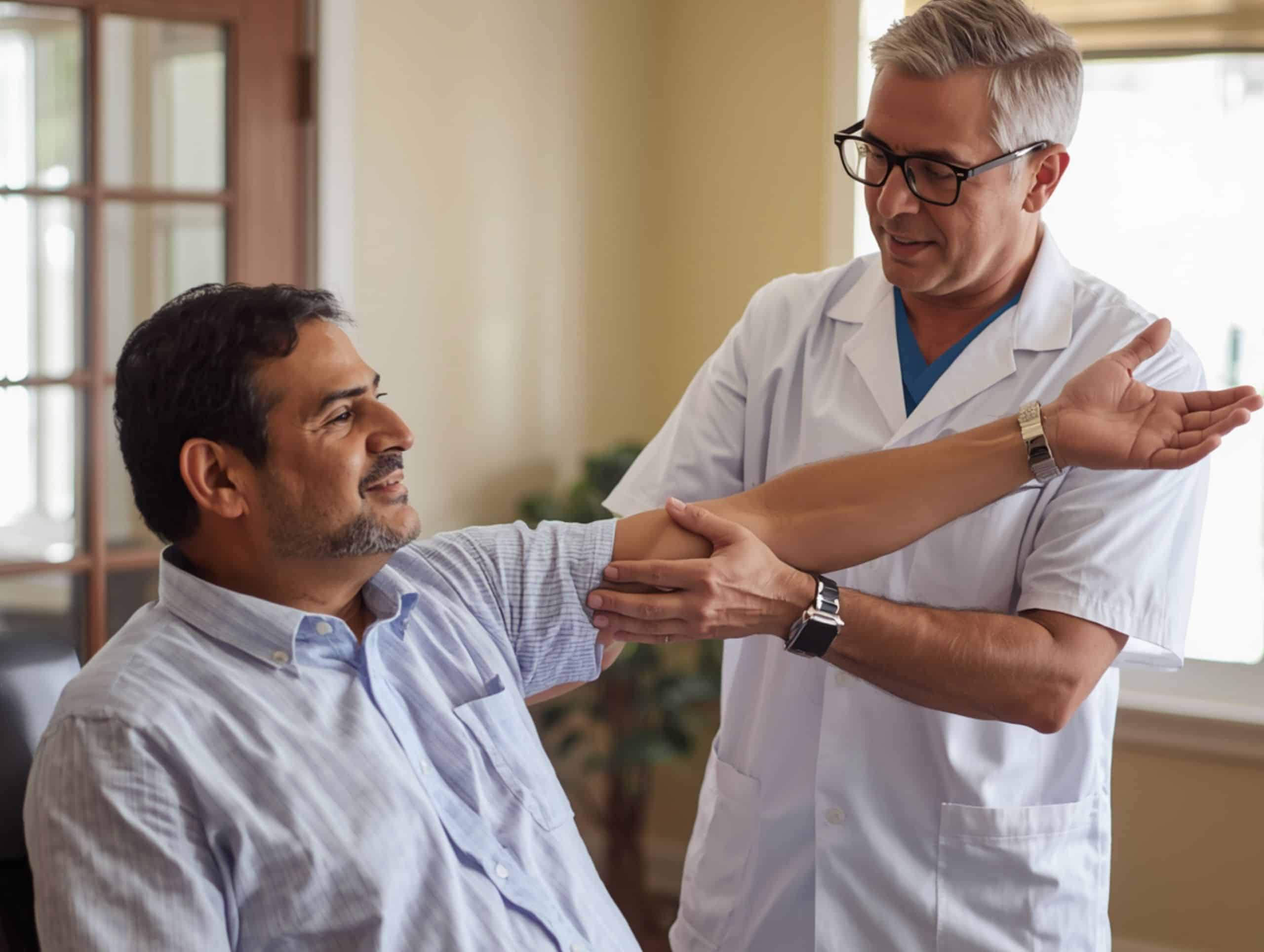
Every joint replacement has a surgeon-prescribed protocol that dictates weight-bearing restrictions, range of motion targets, precaution positions (movements to avoid), and progression timelines. Our therapy team follows that protocol precisely — because deviating from it risks damaging the implant or the healing tissue around it. For total knee replacement patients, the primary goal in the first weeks is restoring flexion — bending the knee to 90 degrees and beyond. Your therapist uses manual stretching, continuous passive motion when ordered, and progressive exercises to push through the scar tissue forming around the new joint. For total hip replacement patients, the focus is gait retraining — correcting the compensatory limp that pre-surgical pain created — while respecting the hip precautions your surgeon prescribed. For shoulder replacement patients, the progression is slower and more cautious, with controlled range of motion exercises that protect the rotator cuff repair while gradually restoring overhead reach.
Our aquatic therapy pools are where joint replacement rehab accelerates. Warm water reduces swelling around the new joint. Buoyancy offloads 50 to 90 percent of your body weight, which lets you practice walking, squatting, and range of motion exercises with dramatically less pain than on land. Our underwater treadmill lets your therapist control walking speed and watch your gait pattern on a video screen in real time — catching compensatory movements and correcting them before they become habits. Our occupational therapy team works alongside PT to retrain the daily living tasks affected by your surgery — getting dressed with hip precautions, showering safely, getting in and out of a car, and using the toilet independently. Before discharge, our home safety evaluation team assesses your home for fall risks and recommends modifications — raised toilet seats, shower benches, grab bars — that make the transition safe. Patients from Arlington, University Park, Fairways Forest, and across Jacksonville are transferred to our facility directly from orthopedic surgery units at Baptist Health, Ascension St. Vincent’s, UF Health, and Mayo Clinic.
Why Joint Replacement Rehab Matters in Jacksonville
Jacksonville’s orthopedic surgery practices perform thousands of hip and knee replacements every year. The surgical techniques have advanced dramatically — many patients are discharged from the hospital within one to two days. But faster hospital discharge doesn’t mean faster recovery. It means the most critical phase of rehabilitation now happens outside the hospital. Patients who go home to do exercises from a printed sheet and attend outpatient PT twice a week often don’t progress as quickly as patients who receive daily, supervised, milestone-driven rehab at a dedicated facility. The difference in outcome between adequate rehab and excellent rehab is the difference between a knee that bends to 95 degrees and one that bends to 125. Between a hip that limps for six months and one that walks normally at six weeks.
At Dolphin Pointe, joint replacement patients get daily therapy in a full-size gym and two heated aquatic pools — resources that most outpatient clinics can’t offer. Our 24-hour nursing team manages pain medication timing, swelling control, wound monitoring, and blood thinner protocols between therapy sessions. And our private suites mean you recover in a room that’s yours — not a shared hospital-style ward. Our partnership with Jacksonville University keeps our rehab team current on the latest joint replacement recovery protocols and evidence-based progression milestones. Families from Colony Cove, Woodmere, San Marco, Mandarin, Regency, and across Duval County choose Dolphin Pointe for joint replacement rehab because the intensity, the aquatic therapy, and the clinical depth match what their surgeon expects — and produce outcomes that home-based recovery rarely achieves.
What to Expect During Joint Replacement Rehab
1. Hospital transfer and protocol review. Your surgeon or hospital discharge planner contacts our admissions team. We review your surgical report, implant type, weight-bearing restrictions, and post-operative protocol. Most transfers happen within one to two days of surgery. On arrival, you’re settled into your private suite and our clinical team reviews the plan with you and your family.
2. Therapy starts day one. Your physical therapist gets you standing, transferring from bed to chair, and taking first steps on the day you arrive. Early mobility is what prevents scar tissue from locking down the new joint. Sessions progress from basic transfers and walking to range of motion exercises, strengthening, aquatic therapy, and gait training on the underwater treadmill.
3. Milestone tracking against surgeon targets. Your surgeon set specific targets — 90 degrees of knee flexion by week two, full weight-bearing by week four, independent stair climbing by week six. Your therapist measures these numbers at every session and communicates progress to your surgeon’s office. If you’re behind on a milestone, the program adjusts. If you’re ahead, we advance.
4. Discharge when milestones are met. You go home when you can walk safely, manage stairs (if needed), get in and out of the car, and perform daily tasks with your new joint. Our team coordinates outpatient rehab for continued progress, provides a home exercise program, and arranges any adaptive equipment you’ll need during the remaining recovery. Your surgeon receives a full progress report with range of motion, strength, and functional data.
Joint replacement rehab is part of our orthopedic rehabilitation program at Dolphin Pointe Health Care. We also offer arthritis management, fracture recovery, and spine rehabilitation under our orthopedic clinic in Jacksonville, FL.
Joint Replacement Rehab Related Programs
Your New Joint Deserves the Best Rehab. Come See Our Facility.
The surgery gave you a new joint. The rehab determines how well it works for the rest of your life. If you or a family member has a hip, knee, or shoulder replacement scheduled — or just had one — call us today to arrange a transfer or schedule your first outpatient visit. Tours are free. We serve patients and families from Arlington, University Park, Springfield, San Marco, Riverside, Mandarin, Orange Park, Regency, Downtown Jacksonville, and the Beaches communities.
Dolphin Pointe Health Care
5355 Dolphin Point Blvd, Jacksonville, FL 32211
Phone: 904-914-8801
Open 24 Hours