
Your hand can’t grip a fork anymore. Your shoulder won’t reach behind your back to put on a bra. Your fingers can’t manage buttons or zippers. You need both hands to open a jar, but one hand doesn’t work since the stroke. These aren’t things you can exercise your way past — they’re permanent or long-term changes in how your body works. But they don’t have to mean you need someone else to do everything for you. Adaptive equipment training at Dolphin Pointe Health Care teaches you how to use simple, effective tools that give you back the ability to eat, dress, bathe, and manage daily tasks on your own. Call 904-914-8801 to schedule an evaluation.
What Adaptive Equipment Training Includes in Jacksonville
Our adaptive equipment program starts with a functional assessment — your occupational therapist evaluates which daily tasks you can’t do independently and identifies whether the barrier is strength, range of motion, coordination, one-sided weakness, or a combination. From there, we match the right tool to the right deficit. For dressing: button hooks, zipper pulls, elastic shoelaces, long-handled shoehorns, sock aids, and dressing sticks. For eating: built-up utensils with thick, textured handles for weak grip, weighted utensils for tremor control, plate guards to prevent food from sliding off, and rocker knives that cut with one hand. For bathing: long-handled sponges, shower chairs, handheld showerheads, and non-slip mats. For kitchen tasks: one-handed cutting boards, jar openers, electric can openers, and ergonomic tools designed for arthritic hands. Each piece of equipment is selected based on your specific deficit — not a generic starter kit.
The training itself is what makes this program effective. Your therapist teaches you how to use each tool, then watches you practice the complete task — not just the tool in isolation. Putting on a shirt with a dressing stick means learning the sequence: lay the shirt out, slide the weak arm in first, pull it over your head, then use the strong arm. Cutting food with a one-handed board means learning how to secure the food, angle the knife, and manage the plate. Every technique is practiced until it’s automatic — until you don’t have to think about the steps anymore. For patients with cognitive deficits who struggle to learn new sequences, our speech therapy team coordinates with OT on the cognitive retraining needed to support the physical technique. Before discharge, our home safety evaluation team confirms that the equipment is set up correctly in the patient’s home. Patients from Arlington, University Park, Fairways Forest, and across Jacksonville work with our OT team on adaptive equipment goals that are measured by independence — “can you dress yourself,” “can you feed yourself,” “can you bathe safely alone.”
Why Adaptive Equipment Training Matters in Jacksonville
The difference between needing full-time help at home and living independently often comes down to four or five daily tasks — dressing, bathing, toileting, eating, and basic kitchen work. When a stroke, surgery, arthritis, or injury takes away the ability to do one or more of those tasks with normal technique, the patient has two choices: depend on someone else to do it for them, or learn a new way to do it themselves. Adaptive equipment provides that new way. And in Jacksonville’s growing population of older adults — many of whom live alone or with a spouse who also has physical limitations — the ability to perform daily tasks independently is the single biggest factor in whether someone can stay home or needs residential care.
Most hospital discharge teams send patients home with a printed list of recommended equipment. A few items might be ordered. But training — supervised, repetitive practice with the actual tools in realistic task scenarios — is rarely part of the hospital discharge process. At Dolphin Pointe, adaptive equipment training is a structured program within our occupational therapy clinic. Our therapists don’t just hand you a tool. They train you to use it until the technique is second nature. For inpatient residents, our nursing team reinforces the techniques between therapy sessions — using the same equipment and the same approach your therapist prescribed. That consistency between therapy and daily care is what makes the training stick. Families from Colony Cove, Springfield, San Marco, Mandarin, and across Duval County choose Dolphin Pointe for adaptive equipment training because we treat it as a clinical program with real outcomes — not a checklist item on a discharge form.
What to Expect During Adaptive Equipment Training
1. Functional assessment. Your occupational therapist evaluates your ability to perform daily living tasks — dressing, eating, bathing, grooming, toileting, and kitchen activities. The assessment identifies which tasks you can’t do independently and pinpoints the specific physical barrier: grip weakness, limited reach, one-sided loss, coordination deficit, or pain.
2. Equipment selection and introduction. Based on your assessment, your therapist selects the specific tools that match your deficits. Each piece of equipment is demonstrated, explained, and placed in your hands. You see how it works before you try it yourself.
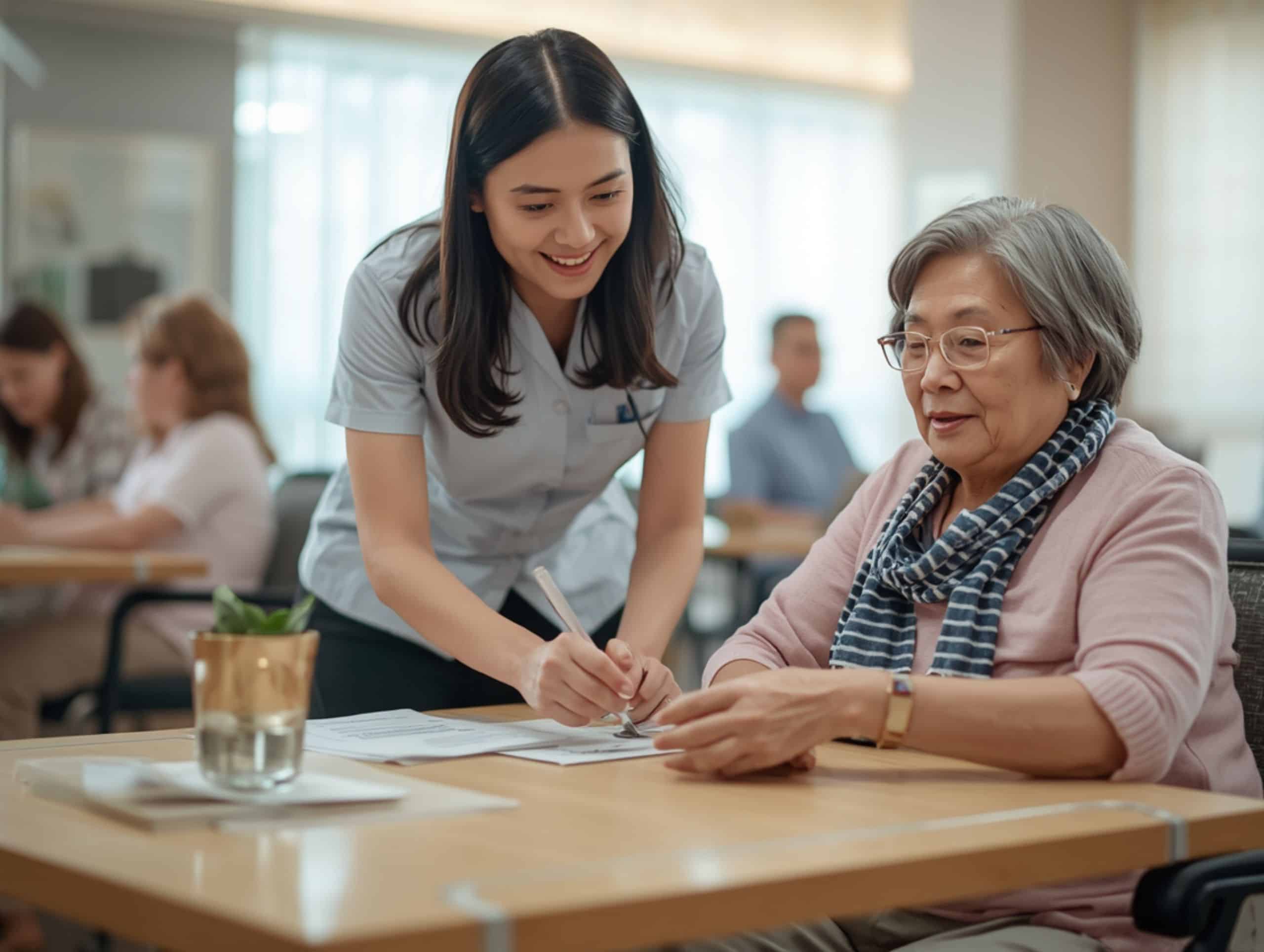
3. Supervised task practice. This is the core of the program. Your therapist watches you perform the complete task — not just use the tool — and corrects your technique, adjusts your approach, and repeats the practice until you can do it independently. Dressing with a dressing stick. Eating with built-up utensils. Bathing with a long-handled sponge. Each task is practiced in realistic conditions until the sequence is automatic.
4. Home setup and discharge. Before discharge, your therapist confirms you have the equipment you need at home. Our home safety evaluation team verifies that bathroom equipment (grab bars, shower chairs, raised toilet seats) is installed correctly. Your family is trained on how to support your new techniques — assisting when needed without doing the task for you. Your referring physician receives a full independence report.
Adaptive equipment training is part of our occupational therapy program at Dolphin Pointe Health Care. We also offer home safety evaluations and daily living skills training under our occupational therapist services in Jacksonville, FL.
Adaptive Equipment Training Related Programs
You Lost an Ability. Not Your Independence. Start Training Today.
If a stroke, surgery, arthritis, or injury has taken away your ability to dress, eat, bathe, or manage daily tasks with normal technique, adaptive equipment can give it back. The tools are simple. The training is what makes them work. Call 904-914-8801 to schedule an occupational therapy evaluation. We serve patients from Arlington, University Park, Springfield, San Marco, Riverside, Mandarin, Orange Park, Regency, Downtown Jacksonville, and the Beaches communities.
Dolphin Pointe Health Care
5355 Dolphin Point Blvd, Jacksonville, FL 32211
Phone: 904-914-8801
Open 24 Hours